
What is a via ferrata?
The complete guide for beginners
Via ferrata , an Italian term that can be translated as " iron route ," is an outdoor activity that involves traversing a specially designed rock face. Metal rungs, cables, walkways, suspension bridges, and zip lines facilitate the ascent, while a lifeline ensures safety throughout the route. A cross between hiking and rock climbing , via ferrata offers an accessible way to experience verticality and gain a new perspective, even without prior experience. But what does an outing involve? What equipment do you need? What are the difficulty levels and risks? The vocabulary may seem a bit technical, and the height impressive at first, but rest assured: via ferrata is above all a fun and exhilarating activity . Here's everything you need to know before you get started… and enjoy the climb!
Via ferrata: definition, principle and operation

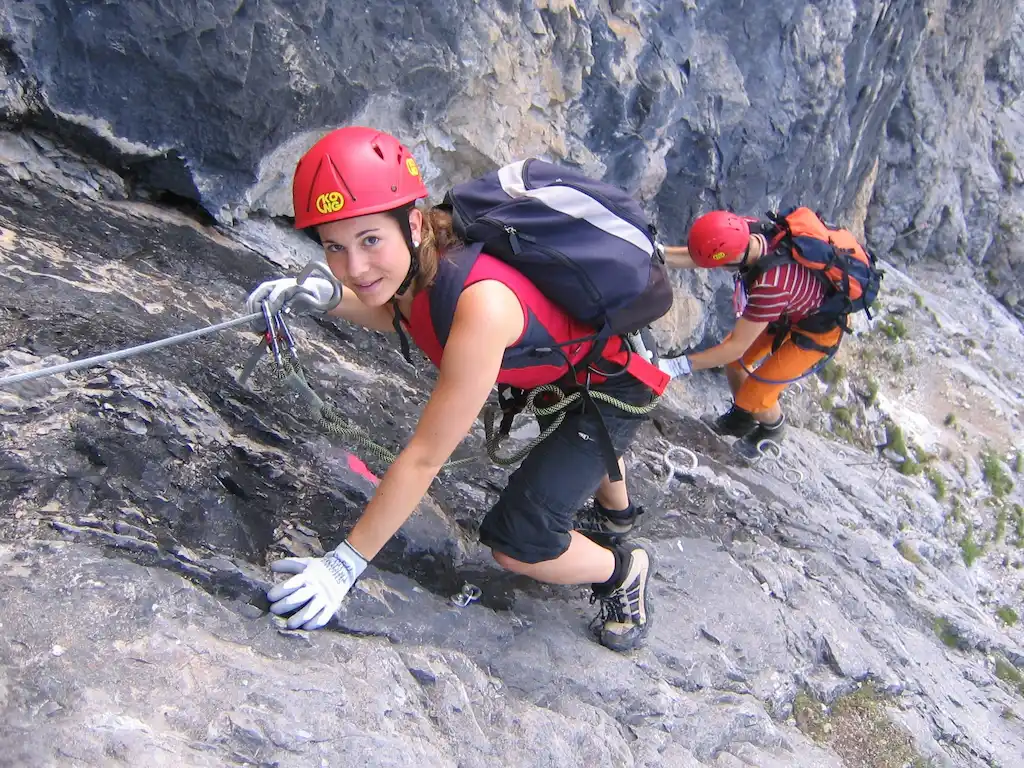
A via ferrata is a route set up on a rock face to facilitate progression. The route is equipped with a continuous cable, called a lifeline , to which the user remains connected, as well as various features allowing progress on the rock face: rungs, bars, metal steps, holds or ramps.
But a via ferrata isn't just about climbing! Depending on the route, you'll have to use walkways , cross rope bridges or Nepalese bridges , move along beams, and sometimes even finish a section with a zip line . You climb, you traverse, you gain altitude… often with a few thrills along the way.
Via ferratas are set up in natural environments, generally in mountainous or particularly steep locations. Their appeal lies in this: they provide access to places that would not be discovered on a typical hike. Thus, as you progress, you reach spectacular viewpoints overlooking the mountains, valleys, and surrounding landscapes.
It's this blend of physical activity, verticality, nature exploration, and the sheer enjoyment of the route that makes via ferrata so appealing. There's no need to aim for a summit at all costs: a good part of the fun lies precisely in savoring the scenery… between two rungs!
What does "via ferrata" mean? Origin and translation
Okay, we couldn't resist: here's a little history lesson! But we promise, it'll be short. 😉
Via ferrata literally means "iron way" in Italian, referring to the metal equipment installed on the walls to facilitate progress.
The first developed routes appeared in the Austrian Alps in the 19th century , before spreading to the Italian Dolomites . During the First World War, cables, ladders, and equipped passages were used by Italian and Austro-Hungarian soldiers to move around in these particularly steep mountains.
In France , it wasn't until 1988 that the first modern via ferrata was created , in Freissinières, in the Hautes-Alpes . Since then, the activity has become much more popular and attracts athletes, hikers, and nature lovers alike, all looking for a slightly more… vertical way to enjoy the scenery!
What happens during a via ferrata outing?

A via ferrata outing usually takes place in several stages. For a first experience, it is recommended to be accompanied by a professional guide : they choose a route adapted to the group's level, explain the progression techniques and ensure that safety instructions are followed.
1. The appointment and the equipment
The outing begins with the distribution of equipment: helmet, harness, and via ferrata lanyard equipped with an energy absorber. The guide checks that everyone is properly equipped before departure.
2. The approach march
Next, you need to reach the start of the via ferrata. Depending on the location, this walk can take a few minutes or constitute a short mountain hike.
3. The safety briefing
Before starting on the wall, the guide explains how to use the lifeline, move the carabiners from one cable to another, and navigate the various obstacles. This is also the time to review the essential rules of progression.
4. Progression on the via ferrata
Then it's time for adventure! Everyone progresses at their own pace along the rungs and rocky passages, while remaining connected to the lifeline. Depending on the route, the progression may include walkways, suspension bridges, traverses, more vertical paths, or zip lines.
The guide remains present to demonstrate the correct techniques, advise the group, and assist participants when a section appears a little more daunting than expected.
5. Exiting the course and returning
Once the via ferrata is completed, a short walk usually leads back to the starting point. It's also a good time to enjoy the scenery one last time… and to realize that the rock face you've just climbed often looks much higher from below!
The total duration varies greatly depending on the length and difficulty of the route, the approach walking time and the level of the participants.
What equipment do you need to do via ferrata?

For via ferrata, three pieces of equipment are essential: a helmet, a harness, and a specific lanyard equipped with an energy absorber and two carabiners , which allows you to remain connected to the lifeline throughout the climb. Shoes with good grip are also crucial, and gloves can provide added comfort on the metal cables.
During a guided outing, the technical equipment is generally provided by the guide , who also checks its settings before departure. If you are climbing independently and already familiar with the progression and safety techniques, it is often possible to rent the necessary equipment near the via ferrata sites.
So there's no need to invest immediately in all the gear for a first outing: good shoes , comfortable clothing and the desire to gain a little altitude are enough to start!
Via ferrata, climbing and hiking: what are the differences?
Via ferrata borrows elements from several outdoor activities: you walk like you're hiking , you move along a rock face like you're climbing , and some bridges or suspended passages may remind you of treetop adventure courses . However, the sensations and techniques are quite distinct.
Here is a comparative table to help you understand:
| Via ferrata | Climbing | Hiking | Treetop adventure course | |
|---|---|---|---|---|
|
Terrain |
Modified rock face
|
Natural wall or artificial wall
|
Trails and paths
|
Courses set up in the trees or on structures
|
|
How do we move forward? |
Rungs, holds, cables, bridges, walkways… walking and climbing |
Natural or artificial intake |
Walking |
Workshops, nets, bridges, zip lines… |
|
securing |
Lanyard attached to a lifeline
|
Rope, harness and belaying system
|
Generally without specific safety equipment
|
Lifeline and harness |
|
technicality |
Variable depending on the level of the course
|
Climbing and belaying techniques to master
|
Highly variable depending on the route |
Variable depending on the level of the course |
|
Sensations |
Verticality, height, emptiness and a playful course
|
Climbing, technique and pushing your limits
|
Effort, discovery and immersion in nature
|
Height, balance and fun workshops
|
The main difference between via ferrata and rock climbing lies in the method of progression. In rock climbing, the climber primarily uses the holds on the rock face and must master specific climbing and belaying techniques. In via ferrata, fixed structures facilitate progression: it is therefore possible to experience verticality without having previously learned to climb.
As for hiking , it generally remains much more horizontal… although some mountain trails are very good at reminding your calves that “hiking” doesn’t necessarily mean “Sunday stroll”! 😉
Via ferrata is therefore an excellent compromise for those who want to gain height, enjoy a spectacular natural environment and experience the sensations of verticality , without necessarily embarking directly on climbing.
Did you know ?
Extérieur Nature organizes via ferrata and climbing trips in the Pyrénées-Orientales all year round.
And from April to November, you can also try out our treetop adventure park , near Perpignan!
What are the difficulty levels in via ferrata?
Not all via ferratas are created equal: some are ideal for a first experience, while others require more strength, endurance and comfort with heights.
In France, courses are generally classified according to six levels of difficulty:
- F – Easy: suitable for discovery;
- PD – Not very difficult: accessible to beginners with a reasonable level of physical fitness;
- AD – Quite difficult: a more challenging route, with more verticality;
- D – Difficult: requires more endurance and ease;
- TD – Very difficult: reserved for experienced and athletic practitioners;
- ED – Extremely difficult: a particularly demanding course.
A + or a – can be added to the rating to clarify it, for example AD+ or TD-. This classification allows you to choose a route suited to your level and physical condition before starting on the wall.
For a first outing, it's best to start modestly: the via ferrata is much more enjoyable when you can take in the scenery rather than wondering, at every rung, why you didn't choose the level just below! 😉
Who can do via ferrata?

Good news: via ferrata is suitable for a very wide audience . Beginners, occasional athletes, families, groups of friends or more experienced practitioners can all find something to enjoy, provided they choose a route adapted to their level and physical condition.
For children , it's essential to consider the minimum age for each route, but also their stamina. A via ferrata can require several hours of effort, with an approach hike, vertical sections, and sometimes a fairly long return walk. Therefore, they must be able to walk for a sufficient amount of time and move around at height without tiring too quickly.
The issue of vertigo also deserves serious attention. Having a slight apprehension about heights doesn't necessarily prevent participation; it may even gradually disappear once you feel safe and secure. However, someone who is very prone to vertigo or panic at heights should choose an easy and relatively unexposed route, preferably accompanied by a professional guide, or simply forgo the activity altogether.
In summary, you don't need to be a great athlete to start: the most important thing is to choose a via ferrata that suits your abilities, endurance and comfort with heights.
"For your first via ferrata, don't choose solely based on duration. Exposure to heights and verticality often matter more than the number of kilometers."
Nico, via ferrata guide at Extérieur Nature
Is via ferrata dangerous? Risks and safety

Via ferrata is a safe activity when practiced with appropriate equipment, on a route matching one's skill level, and in good conditions . However, like any mountain activity, it carries risks: falls, fatigue, misuse of equipment, or sudden changes in weather.
Before setting off, it is therefore essential to choose a via ferrata that matches each person's physical and technical abilities, as well as their comfort level with heights. For a first outing, being accompanied by a professional guide is strongly recommended: they explain the progression methods, check the equipment, and adapt the pace to the group.
The weather must also be carefully monitored. Rain, storms, strong winds, extreme heat, or adverse conditions can make progress more difficult or dangerous. It is also essential to check that the route is open and to follow any local restrictions.
Finally, the lifeline and the lanyard with energy absorber are there to protect the user. But they don't make a fall inconsequential: it is therefore necessary to move with care, respect the instructions, and avoid deliberately putting oneself in a situation where one might fall.
In summary: choosing your route carefully, checking the weather, using the right equipment and not overestimating your abilities allows you to fully enjoy the experience… with the sensations, but without taking unnecessary risks.
When is the best time to do via ferrata?
Via ferrata can be practiced almost all year round , but the most pleasant conditions are generally found in spring, summer and autumn.
In spring , temperatures are often ideal for exertion and the landscapes are particularly pleasant.
In summer , the long days allow you to fully enjoy the experience, but beware of the intense heat! On routes with walls that are very exposed to the sun and have little shade, it is best to start early in the morning or in the middle of the afternoon to avoid the hottest hours.
Autumn is also an excellent season, with milder temperatures and generally fewer crowds. However, caution is advised in case of rain, which can make the rocks and equipment slippery.
In winter , the activity remains possible on some open sites, but the days are shorter and the weather conditions more challenging: cold, wind, rain, snow or frost can make some routes impassable.
Regardless of the season, always check the weather forecast, the day's conditions, and whether the via ferrata is open before setting out. If a storm is forecast, strong winds are expected, or there's a heatwave, it's best to postpone your trip: the mountain will still be there tomorrow!
Where to go via ferrata in the Pyrénées-Orientales?

To discover via ferrata in the Pyrénées-Orientales , head to Saint-Paul-de-Fenouillet , about 40 minutes from Perpignan. Between limestone cliffs, the Corbières hills and the Roussillon plain, the site offers a spectacular setting to gain altitude… and enjoy the scenery!
Extérieur Nature offers two via ferrata routes , accompanied by a state-certified guide and adapted to different profiles:
- La PichonaAccessible from age 8, this is a discovery trail lasting approximately 2 hours. Progressive and fun, it is particularly suitable for families and beginners who wish to get a gentle introduction to the sport.
- The PanoramicAccessible from age 14, it lasts approximately 4 hours. More aerial and more athletic, it includes vertical sections and is aimed at practitioners comfortable with heights who are looking for more thrills.
Outings are offered year-round by reservation , subject to favorable weather conditions. Technical equipment is provided, and for experienced climbers, Extérieur Nature also offers rental of specific via ferrata equipment.
So, would you prefer a first-time experience at La Pichona or want to gain even more altitude at La Panoramique ? To help you choose:
Photo credits :
- Savognin Tourismus, CC BY-SA 3.0 via Wikimedia Commons
Speikboden AG, CC BY-SA 4.0 via Wikimedia Commons
Fandubarca, CC BY-SA 3.0 via Wikimedia Commons
Ismith, CC BY-SA 3.0 via Wikimedia Commons
Krishna Naudin, CC BY-SA 2.0 via Wikimedia Commons
Evelyne Chassagneux-Bonini, CC BY-SA 4.0 via Wikimedia Commons
- Laure Piqueras
Read also:

7 Group Activity Ideas in the Pyrénées-Orientales
What to do as a group in the Pyrénées-Orientales? 7 ideas for a successful outing. Are you looking for group activity ideas in the Pyrénées-Orientales?

What to do near Perpignan when it's hot? 11 great ideas
11 ideas to stay cool near Perpignan, even in the middle of a heatwave. When the thermometer climbs above 35°C near Perpignan, one question keeps coming up.

What to do with teenagers in the Pyrénées-Orientales?
8 family activities in the Pyrénées-Orientales that teenagers really enjoy. Does your teenager often respond with "Meh..." or "That's rubbish..." to a suggestion of

Father’s Day Activity Gift: 8 Ideas Around Perpignan
8 original Father's Day gift suggestions in the Pyrénées-Orientales Are you looking for an original gift idea for Father's Day?